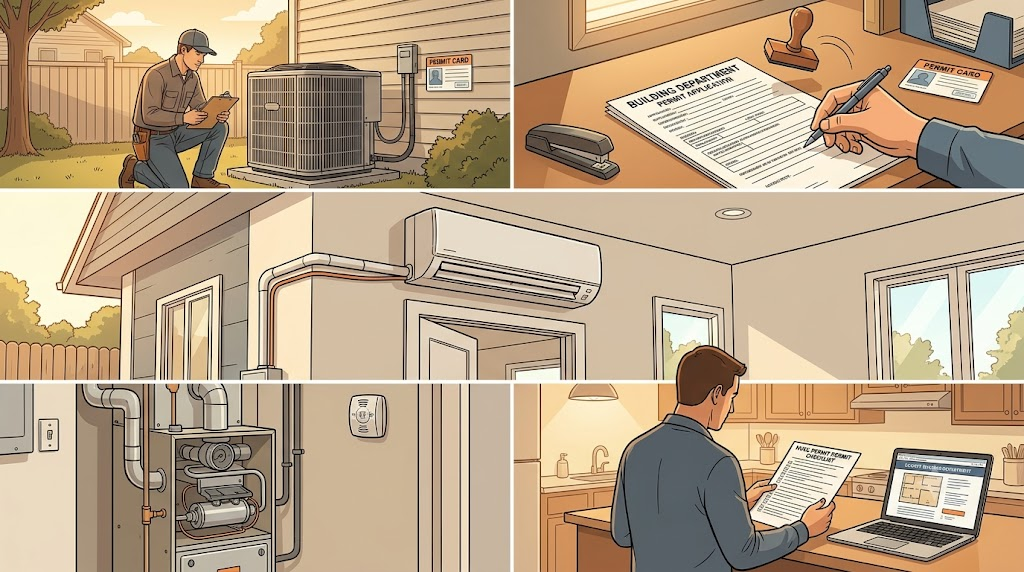
The answer depends on your state, county, and project type. HVACPermitGuide is the only free, county-by-county directory that gives homeowners a plain-language answer — before you call a contractor.
These pages cover the counties where homeowners search most for HVAC permit answers — with real fees, real timelines, and links directly to building department portals.
Kentucky was the first state to mandate statewide HVAC permitting (2011). Learn what's required, who can pull a permit, and how the homeowner exemption works.
Read Guide →$105 residential permit fee, online portal, emergency same-day permitting available. Detailed guide for NKY homeowners and contractors.
Read Guide →Cincinnati metro HVAC permit requirements, fees, the difference between city and county jurisdiction, and how to avoid double-permitting mistakes.
Read Guide →Ductless mini-splits require both a mechanical and electrical permit in most states. Here's the state-by-state breakdown before you buy equipment.
Read Guide →The rules for homeowner-pulled HVAC permits vary dramatically by state. Some states allow it freely; others prohibit it entirely. Find yours here.
Read Guide →What actually happens if HVAC work is done without a permit — from failed home sales to insurance claim denials and fines. The real consequences explained.
Read Guide →Most homeowners picture mountains of paperwork. The reality for a straightforward HVAC replacement is simpler than you think — typically one form, one payment, and one inspection.
Use our decision tool above or read your state guide. In most states, replacing a central AC or furnace requires a mechanical permit. Mini-splits almost always require both a mechanical and electrical permit.
In most states, a licensed HVAC master contractor pulls the permit on your behalf. In Kentucky, Ohio, and Florida, homeowners may pull their own permit for their primary residence, with some restrictions.
Residential HVAC replacements rarely require plan review. Most counties issue permits within 24–48 hours of application. Emergency installations are usually accommodated with a retroactive permit the next business day.
For replacements, only a final inspection is usually required (no rough-in). The inspector checks refrigerant lines, electrical connections, flue venting, and unit placement. Most inspections take 20–30 minutes.
After passing inspection, the permit is closed and recorded. Keep a copy — you'll need to reference it if you sell the home or file an insurance claim.
Click any state for a full guide covering permit requirements, fees, homeowner-pull rules, and county-level details.
| State | Permit Required? | Homeowner Can Pull? | Typical Fee | State Code Basis | Full Guide |
|---|---|---|---|---|---|
| Kentucky | Required — All Projects | Yes (1x per 5 yrs) | $75–$150 | KRS 198B / DHBC | Guide → |
| Ohio | Required | Check local | $80–$200 | Residential Code of Ohio (IRC 2021) | Guide → |
| Florida | Required | Yes (most counties) | $100–$250 | Florida Building Code (FBC) 8th Ed. | Guide → |
| Texas | City/County Varies | Check local | $75–$175 | No statewide mandate | Guide → |
| California | Required | Yes (own home) | $150–$400 | California Mechanical Code (CMC) | Guide → |
| Georgia | Required | Yes (owner-builder) | $75–$200 | Georgia State Minimum Standard Codes | Guide → |
| Tennessee | Required | Limited | $75–$150 | Tennessee State Fire Marshal / local | Guide → |
| Indiana | Varies by County | Check local | $50–$150 | Indiana Building Code (IBC/IRC) | Guide → |
| North Carolina | Required | Yes (own home) | $75–$200 | NC Residential Code / NCMC | Guide → |
| Virginia | Required | Yes (owner-occupant) | $75–$175 | Virginia Uniform Statewide Building Code | Guide → |
The master guide. Covers every scenario: replacements, new installs, mini-splits, repairs, and emergency situations.
Read →Real fee data from building departments across all 50 states. Know what to expect before your contractor quotes you.
Read →A step-by-step walkthrough of what an HVAC inspector checks and what causes a re-inspection — written for homeowners, not contractors.
Read →Permit timelines vary widely. Some counties approve in hours; others take a week. Find out what drives the difference.
Read →Work was done without a permit. What now? How to get your HVAC work permitted after the fact — and what it costs.
Read →Heat pumps are the fastest-growing HVAC category. Requirements vary because they straddle heating and cooling categories in some state codes.
Read →Landlords face stricter consequences for unpermitted HVAC work. Here's what landlords need to know in every state.
Read →Manufactured and mobile homes follow different rules — often the HUD code rather than the IRC. Full breakdown by state.
Read →Everything you need before, during, and after your HVAC permit — in a single printable checklist. No email required.