The Short Answer
In virtually every US state, installing a ductless mini-split requires at minimum a mechanical permit. In most states, it also requires a separate electrical permit for the dedicated circuit. "DIY-friendly" mini-splits (like Mr. Cool DIY) still require permits — the permit requirement is about the installation, not who makes the equipment.
Why Mini-Splits Often Require Two Permits
A standard central HVAC replacement typically requires just a mechanical permit, because the electrical circuit and panel connections are usually unchanged. Mini-split installations are different for a key reason: most require a new dedicated electrical circuit that didn't previously exist.
The breakdown:
- Mechanical permit: Covers the refrigerant line set, air handler mounting, outdoor condenser placement, and the mechanical aspects of the installation. Required in nearly every state.
- Electrical permit: Covers the new dedicated circuit from the electrical panel to the outdoor unit, the disconnect box, and wiring to the air handler. Required whenever a new circuit is run — which is almost always the case for a new mini-split installation.
In some jurisdictions, a single "combo" permit covers both mechanical and electrical work for residential mini-splits. In others (like Hamilton County, Ohio), separate permits must be filed with separate inspections. Always ask both the HVAC and electrical permit offices when applying.
The Refrigerant Rule — Even for DIY Kits
This is where many homeowners get tripped up by "pre-charged" or "DIY-friendly" mini-split kits. Products marketed as DIY mini-splits come with pre-charged refrigerant line sets that don't require a vacuum or recharge — which means a homeowner can do the physical installation. But:
- The permit requirement still applies regardless of whether you use a DIY kit or a contractor-installed system
- In most states, handling refrigerant (including connecting or disconnecting pre-charged line sets) still requires EPA Section 608 certification
- In Kentucky specifically, a licensed technician must handle all refrigerant even if the homeowner does all other work
- The homeowner may be able to pull the permit themselves in states that allow homeowner-pull (see our guide), but that doesn't eliminate the permit requirement
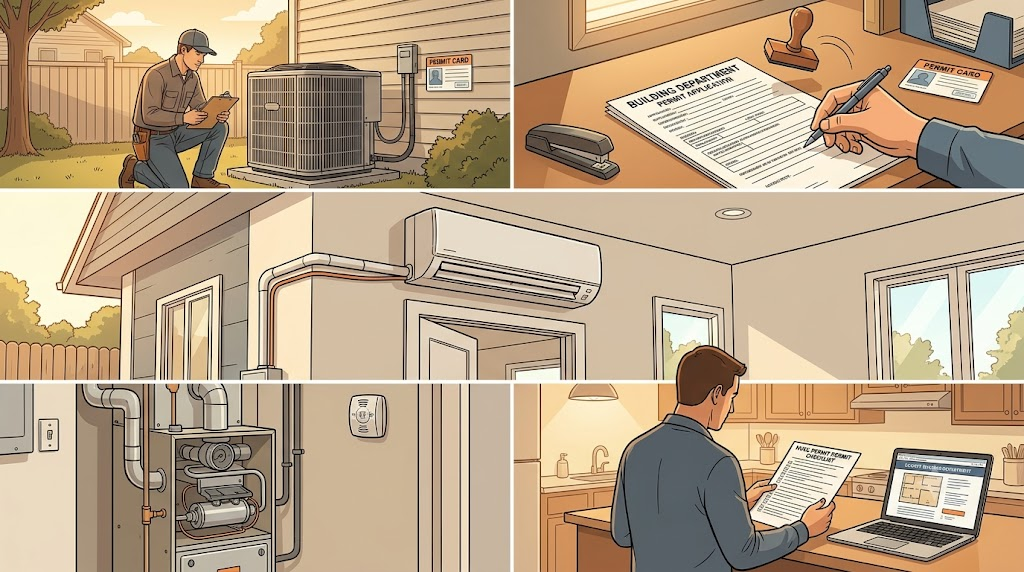
State-by-State Mini-Split Permit Requirements
| State | Mechanical Permit Required? | Electrical Permit Required? | Homeowner Can Pull? | Notes |
|---|---|---|---|---|
| Kentucky | Yes | Yes (separate) | Yes — once/5 yrs | Refrigerant must be handled by licensed tech. See KY guide. |
| Ohio | Yes | Yes (often separate) | Check local AHJ | Hamilton County and Cincinnati both require separate mechanical and electrical permits. See Hamilton County guide. |
| Florida | Yes | Yes | Yes (most counties) | Florida Building Code covers mini-splits explicitly. Many counties accept a combined HVAC/electrical application for residential ductless units. |
| Texas | City/county varies | City/county varies | Check local | Houston and Dallas require permits. Rural Texas may not. Confirm with your local building department. |
| California | Yes | Yes | Yes (own home) | California Mechanical Code mandates permits. C-20 license required for contractor pulls. Some counties (LA, Orange) process mini-split permits online. |
| Georgia | Yes | Yes | Yes (owner-builder) | Owner-builder exemption available for own residence. Both permits typically required by all Georgia local AHJs. |
| Tennessee | Yes | Yes | Limited | State Fire Marshal has statewide mechanical code. Electrical permit required separately. |
| North Carolina | Yes | Yes | Yes (own home) | NC Mechanical Code adopted statewide. Permits required even in rural counties. |
| Virginia | Yes | Yes | Yes (owner-occupant) | Virginia Uniform Statewide Building Code applies statewide. |
| Indiana | Varies by county | Varies by county | Check local | No true statewide HVAC permit mandate. Urban counties (Marion, Lake, Allen) require permits. Some rural counties do not. |
| Michigan | Yes | Yes | Yes (own home) | Michigan Mechanical Code is statewide. Homeowners may act as own contractor for primary residence. |
| Pennsylvania | Yes | Yes | Limited | Pennsylvania UCC applies statewide but administration is municipal. Mini-splits in Philadelphia require permits through the city's eCLIPSE system. |
| New York | Yes | Yes | Limited (NYC: No) | New York City requires licensed contractors only. Upstate NY building departments vary — confirm locally. |
| Colorado | Yes | Yes | Yes (own home) | Colorado has statewide building code. Denver and Front Range municipalities all require permits for mini-splits. |
| Washington | Yes | Yes | Yes (own home) | Washington State Energy Code mandates permits. High mini-split adoption rate due to climate incentives. |
| Oregon | Yes | Yes | Yes (own home) | Oregon Mechanical Specialty Code requires permits. Homeowner-contractor provisions available in most jurisdictions. |
| Arizona | Yes | Yes | Yes (most cities) | Maricopa County (Phoenix area) requires permits. Most AHJs have online portals. |
| Nevada | Yes | Yes | Yes (own home) | Clark County (Las Vegas) and Washoe County (Reno) both require permits for mini-splits. |
| Illinois | Varies (Chicago: Yes) | Yes | Check local | Illinois has no statewide mechanical code, but Chicago requires permits. Cook County suburban municipalities have their own requirements. |
What Inspectors Check on a Mini-Split Installation
Mini-split inspections cover more ground than a central HVAC replacement because both the mechanical and electrical work must be verified. Here's what to expect:
Mechanical inspection:
- Air handler mounting — proper wall anchoring, clearances, level installation
- Refrigerant line set routing, insulation, and protection through walls/penetrations
- Outdoor condenser placement — clearances from structures, proper pad or bracket mounting
- Line set penetration sealing (fire stopping, weatherproofing)
- Condensate drain routing — proper slope, trap, termination
- Equipment data plates matching the permit application
Electrical inspection:
- Dedicated circuit from panel — correct breaker size per manufacturer specs
- Disconnect box within sight of outdoor unit, properly sized and listed
- Wiring from disconnect to unit — correct wire gauge, connections, weatherproofing
- Low-voltage wiring between indoor and outdoor units
- Ground fault protection where required
Why Getting the Permit First Matters for Mini-Splits
Mini-splits are unique because they're often installed in garages, sunrooms, home offices, or additions — spaces that didn't previously have HVAC and may have other code compliance issues that come to light during a permit inspection. A few real-world scenarios:
- Garage conversions: Installing a mini-split in a converted garage can trigger questions about insulation, fire separation from the main house, and electrical capacity. These are things you want to know before you spend $3,000–$6,000 on equipment and installation.
- Older electrical panels: Many inspectors flag undersized panels during mini-split electrical inspections. If your panel is already near capacity, the inspection prompts a conversation — not a crisis — before something trips.
- Attic or crawl space penetrations: Line sets running through unconditioned spaces must be properly insulated and sealed. An inspection catches missed insulation before it becomes an efficiency or mold problem.